
Indian students are looking at destinations that offer quality education coupled with unique cultural and career experiences, often at more affordable costs, says Gaurav Batra, CEO, Infinite Group.

'The Budget needs to focus more on social welfare schemes.'

One hopes in his next term, Narendra Modi will take up the mission of inculcating respect for following rules in Indians as a mission. Therein lies the chance for India to become a developed country, asserts Colonel Anil A Athale (retd).

Nilekani is the president of NCAER's governing body, while Rohini Nilekani is the Founder-Chairperson of Arghyam, a foundation that supports initiatives around the country for safe and sustainable water and sanitation.
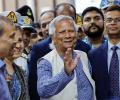
Muhammad Yunus proved that he was neither an armchair economist nor a slogan mongering political activist, but a doer destined to do what Mahatma Gandhi said -- to remove every tear from every eye, recalls Rup Narayan Das.

After the 1962 War with China, there was a demand to forge greater defence cooperation between India and the West. One such voice was that of Sudhir Ghosh, a distinguished MP, to tie up strategic cooperation with the USA immediately after the Chinese attack on India, recalls Rup Narayan Das.

Ms Swaraj was a conscientious woman who understood suffering and pathos and attempted in her inimitable way to mitigate them, recalls Rup Narayan Das.

Those who worry that the Adani saga will turn the world off India are not looking at the entire picture, asserts Mihir S Sharma.

Economist Deepak Nayyar says economic openness, while necessary, is not sufficient, and is conducive to development only when combined with industrial policy.

The United Kingdom extracted USD 64.82 trillion from India over a century of colonialism between 1765 and 1900 and USD 33.8 trillion of this went to the richest 10 per cent -- enough money to carpet London in notes of 50 British pound almost four times over.

Banerjee, 58, was educated at the University of Calcutta, Jawaharlal Nehru University and Harvard University, where he received his Ph.D in 1988. He is currently the Ford Foundation International Professor of Economics at the Massachusetts Institute of Technology.
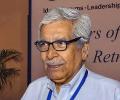
For Yoginder, it is a release from pain. But for us, his friends, it is the loss of a warm and generous life companion, says Nitin Desai of his 50-year association with the eminent economist who passed into the ages on December 6, 2022.

'If there is a push towards a Marxist oriented government it will be dangerous.' 'We have seen this in Nepal and Myanmar and it will be a concern for India if it is surrounded by countries with such political dispensations.'
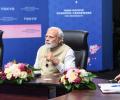
As US President Joe Biden launched a new trade deal with 12 Indo-Pacific nations, including India, to enhance trade, economic and investment opportunities, China, which sees the pact as a threat to its dominance in the region, went on the offensive against it, promising more opening up, while the official media here termed it as "economic Nato".

For India to view the new Sri Lankan leadership only through the prism of the past or through their narrow view on China, is fraught with possibilities that should be avoided, asserts N Sathiya Moorthy.

Engagement with neighbours is a strategic imperative, and not an option, asserts Rup Narayan Das.

Forty-five specialists will soon be joining key posts of joint secretaries, directors and deputy secretaries in different central ministries as part of the Modi government's ambitious plan to infuse fresh talent to further improve ease of governance.
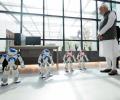
'We are calling companies to set up assembly plants for mobile phones while all the components are imported.' 'Only the last turn of the screwdriver is done here. And you call it self-reliance, Atmanirbharta, etc.' 'Unless you invest in research, you will not climb up the ladder. But this government is happy getting sub-contract work.'

During the day-long debate, the lines between science and religion often got blurred with many invoking religious texts and the contribution of 'rishi munis' to highlight India's tryst with the extra-terrestrial world.

I suggest we build a Vigyan Mandir (Temple of Science) with the ambience of a place of worship, so that it becomes a destination for pilgrims. We should embed on its walls bronze plaques describing each scientist mentioned here along with about a dozen of our ancient mathematicians, recommends Professor Kalyan Singhal, historian of science and technology.

India needs to unleash technological and social innovations that can usher in a new developmental model the world has not seen before, TCS Vice-Chairman S Ramadorai said.

Apart from the human body, human food will bear direct repercussions. From staples such as wheat, to coffee, dairy, and even the great Hilsa face the threat of reduced supply due to the extreme heat.

Rashtriya Swayamsevak Sangh mouthpiece "Panchjanya" has alleged that Jawaharlal University is home to "a huge anti-national block which has the aim of disintegrating India."

Chief Minister MK Stalin has shown that he is cut from a different cloth when it comes to embracing what is current, modern and absolutely necessary. Thus, even while retaining the spirit and content of the pan-Tamil, Dravidian socio-political and socio-economic ideology to the 't', his government has also acknowledged the need to accepting scientifically-proven facts in operational matters, says N Sathiya Moorthy.

There is nothing to be worried about as bilateral ties are robust with solid foundations. Both are on the same page on the economic and defence/security ties bilaterally and globally and that shall continue irrespective of change in political dispensation in either country, points out Dr Rajaram Panda.
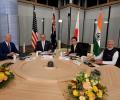
Saturday's Quad meeting in Delaware is taking place against the backdrop of China's assertive behaviour in the South China Sea, its sabre-rattling in the Taiwan Strait and increasing footprints in the Pacific and Indian Ocean, asserts Rup Narayan Das.

'Even though as Xi will seemingly continue to stay in power beyond his third term, competitions for the post-Xi leadership would be inevitably unfolded beneath the surface of water, and that will be a big headache for Xi the dictator.'

Times have changed, situations have changed, but the basic nature of superpower geo-politics remains the same and so also India's diplomacy -- call it non-alignment, strategic autonomy or neutrality; it all depends on the time scale, notes Rup Narayan Das.

Ahead of the upcoming elections, political parties have started announcing incentives to benefit women, but what do women truly seek for genuine gender parity, asks Nivedita Mookerji.

Indian society may be more advanced than we think it is, notes Ajit Balakrishnan.

He also said that infrastructure development in the country in the last eight years has been done with a human touch.

India cannot ignore the neglect of climate finance by the developed nations, Modi asserted at G20 session

Although the credit for acquiring the technological skill must be given to India's outstanding nuclear scientists, the decision to go nuclear was a political one that entailed clarity of vision, courage and resolve, points out Rup Narayan Das.

'It has a natural inclination to foster as much competition among civilian politicians as possible.'

'Everybody says 5G and communication is important.' 'Everybody says automation, robotics, human computing interfaces -- people and machines working together -- is the future.' 'Everybody agrees that cybersecurity is something that is here to stay.' 'Everybody agrees that synthetic biology is important.' 'Instead of outlining thinking about industries for tomorrow and the future, let the evolutionary pathway be built in a way that it promotes robust, creative, thinking.'

The scaling up of the India-US strategic partnership to the level of non-NATO ally with defence deals, sharing and transfer of defence technology, interoperability, joint collaboration and joint production of defence equipment has exacerbated Moscow's anxiety, notes Rup Narayan Das.

An official announcement to this effect would be made next week. The vice-chairman would be of Cabinet rank.

The party is finding increasing acceptability in the 18-35 years age group with Rahul Gandhi adding a million followers in the past 2 months and Facebook and Twitter also seeing similar spikes.

The Centre has constituted a five-member expert committee to study various alternatives available to it to decide on a new capital for Andhra Pradesh.

The PMO said mass yoga demonstrations will be organised at 75 iconic locations across the country under the leadership of 75 Union ministers, with Modi attending the exercise at Mysore.
